Collaborative research program generates promising results for in-situ steam generators
March 2, 2026
Once Through Steam Generators, or OTSGs for short, are the heartbeat of in-situ oil sands operations. They heat water to produce steam, which is then injected several hundred metres underground to soften bitumen so it can be pumped to the surface for processing. With more than 250 OTSGs in operation across the industry, removing barriers for increased efficiency stands to make a significant impact.
One major obstacle to increasing efficiency is fouling. This occurs when organic and inorganic materials build up in the boiler tubes, eventually restricting flow, similar to cholesterol building up in an artery. The build-up can also cause overheating, which can lead to pipe failure.
To help address the issue, COSIA (the innovation arm of Oil Sands Alliance) is engaged in a five-year, $2-million research project focused on reducing buildup, erosion and corrosion in OTSGs. The project is a true collaboration involving the University of Calgary, the University of Alberta, the University of New Brunswick and the Southern Alberta Institute of Technology (SAIT) Centre for Energy Research and Clean Unconventional Technology Solutions. The project is also supported in part by funding from the Natural Sciences and Engineering Research Council of Canada (NSERC).
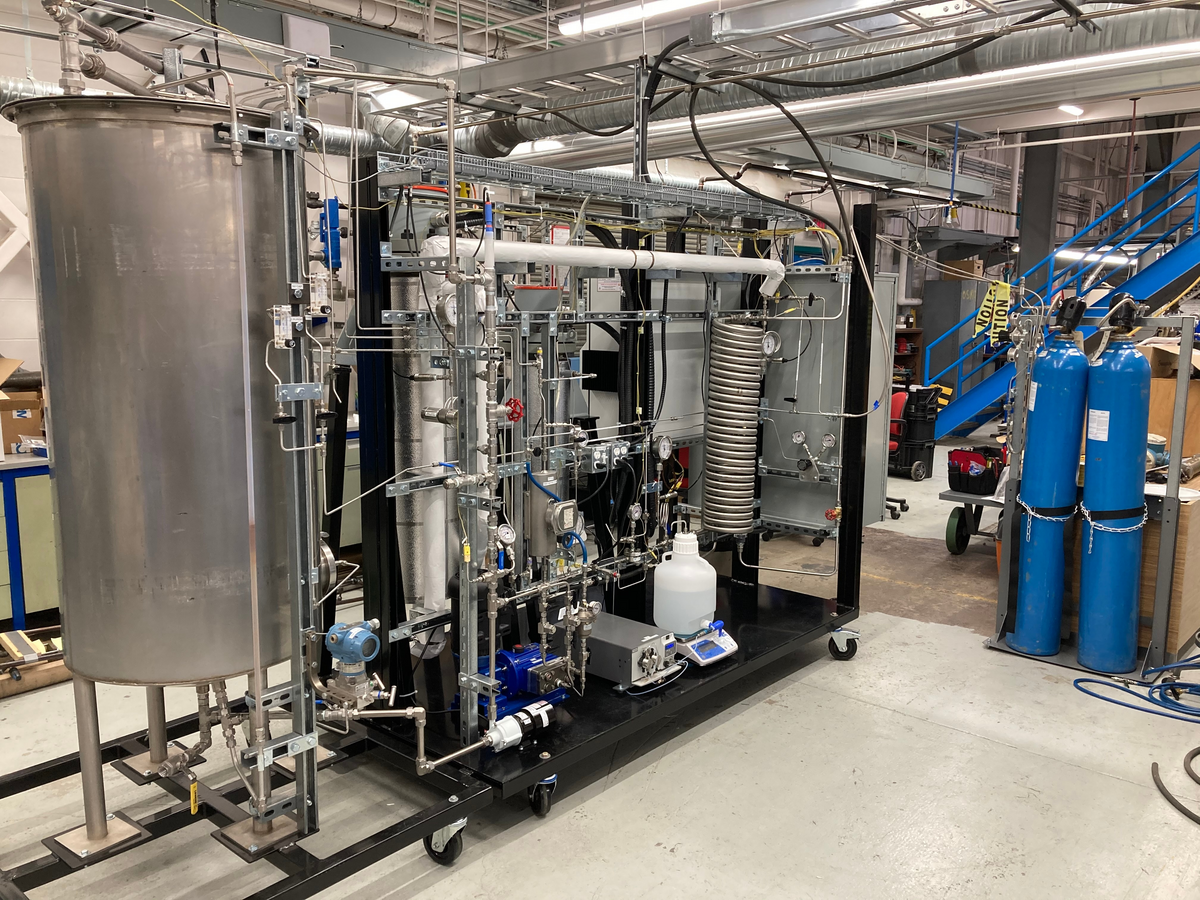
University researchers are studying fundamentals at the beaker scale, and as part of the project, have access to three pilot-scale OTSGs, to test their findings at a significantly larger scale, more closely mirroring real world OTSG operating conditions. Two of the pilot scale rigs were built using ConocoPhillips’ intellectual property and were scaled down to 1/1000th of the size compared to an industrial generator and are used to study buildup challenges. The third pilot-scale OTSG is based on a design codeveloped by Suncor and the University of Alberta, which focuses on addressing corrosion and erosion challenges. All three pilot rigs allow researchers to safely conduct around 20 experiments every year to evaluate various boiler feed water chemistries, test synthetic feed water formulations and assess chemical additive treatments without risking plant operations.
The collaboration between the applied research team at SAIT, university researchers and COSIA brings practical knowledge, fresh insights and real-world experience together to align with current market needs and standards.
The initial university research program, which wrapped up in 2024, yielded promising results. The collaboration was extended for four years in May 2025, and expanded to include the University New Brunswick when NSERC confirmed they would provide matching funds to COSIA’s industry support to optimize OTSG operating conditions. Also in 2025, SAIT opened the doors to a research facility in Quarry Park, a $37-million lab donated by Imperial. The donation of the lab, which represents the largest corporate gift to a post-secondary institution in Alberta’s history, supports the expansion of SAIT’s energy innovation and applied research program. Learn more about the donation.