March 2026
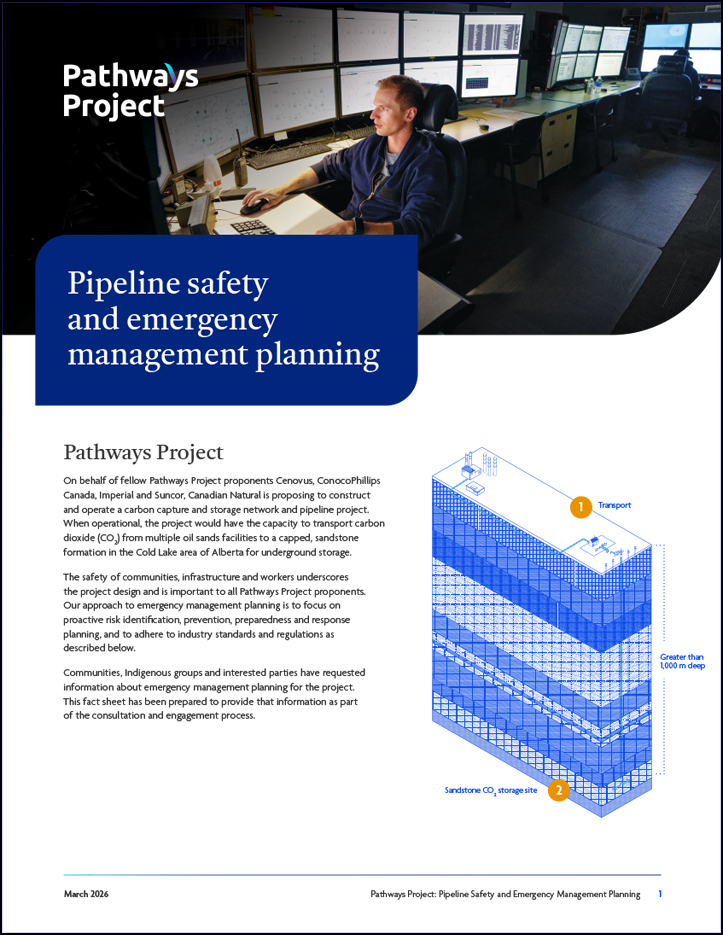
The proposed Pathways Project would transport captured CO2 from oil sands facilities to a deep sandstone formation in the Cold Lake area of Alberta. Safety of communities, infrastructure and workers is central to the project design, with emergency management planning focused on proactive risk identification, prevention, preparedness and response.
Standards and design requirements
The Pathways Project pipeline will be designed, installed and inspected according to Canadian Standards Association (CSA) Z662 standards for pipelines transporting liquid CO2, with some design features exceeding these standards.
Multi-layered pipeline safety system
Pipeline safety is supported by a multi-layered system that includes:
- Prevention – Careful route selection and pipeline design standards
- Detection – Continuous monitoring, leak detection, pipeline integrity and corrosion management plans and control room monitoring
- Response – Alarms, emergency shutdown procedures and emergency preparedness plans
Emergency planning
Emergency Response Plans (ERPs) and Emergency Planning Zones (EPZs) support coordinated response procedures in the unlikely event an incident occurs.
This fact sheet covers:
- The Pathways Project CO2 Transportation Network and its pipeline safety framework
- Routing considerations including safety and environmental factors
- Monitoring systems and operational safety planning
- Emergency Response Plans (ERPs) and Emergency Planning Zones (EPZs)