The art of the nation-building deal
November 4, 2026
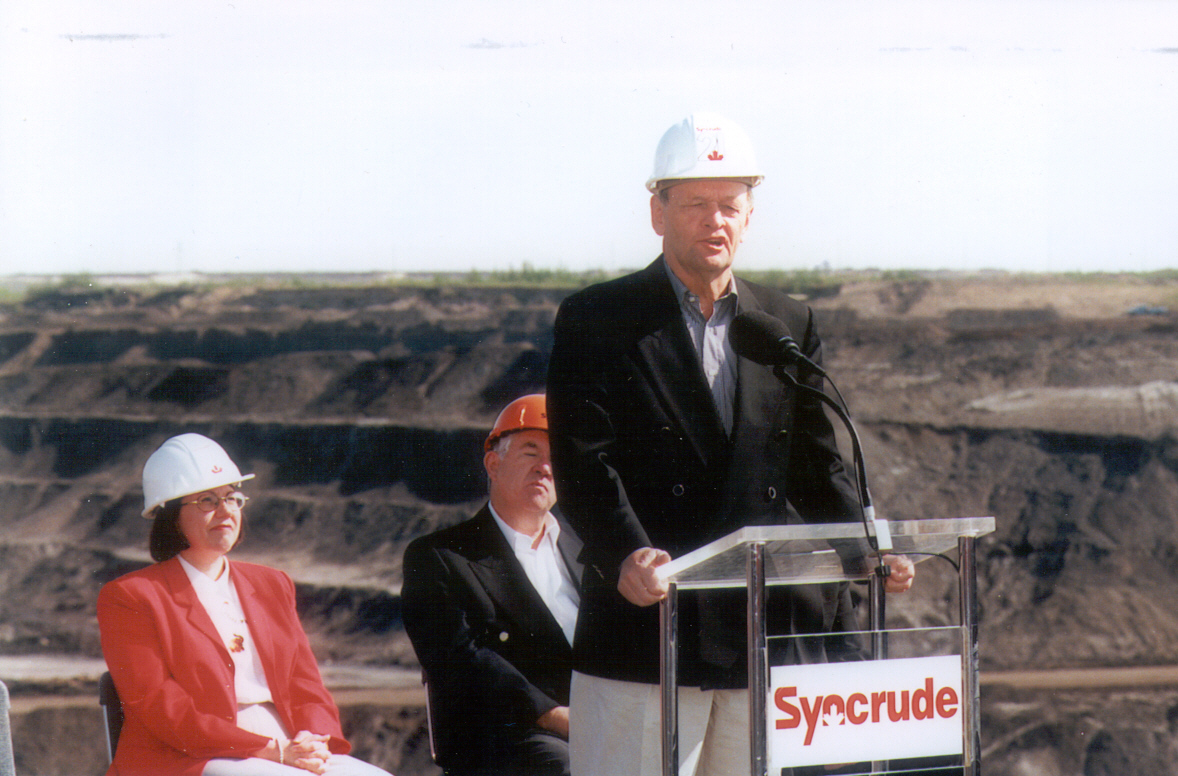
In 1996, a first-term Liberal prime minister, a conservative Alberta premier and the leaders of an ambitious industry gathered in Fort McMurray to make a bet on the future of Canada’s oil sands.
The headlines that followed captured the scale of the moment. “Oil Sands Reappear on Political Stage,” reported The Globe and Mail. The Edmonton Journal put the promise more bluntly across its front page: “44,000 Jobs from the Sands.”
They could almost be headlines from July 2026 following the memorandum of understanding (MOU) signed between Ottawa, the Alberta government and the Oil Sands Alliance, which represents five of the largest producers in the sector.
But they were written three decades earlier, when the Declaration of Opportunity brought Prime Minister Jean Chrétien, Premier Ralph Klein, cabinet ministers and energy executives to the same table. The agreement created the conditions for growth, helping move the oil sands from roughly 450,000 barrels a day in the mid-1990s to about 3.5 million barrels today — a transformation that helped make Canada one of the world’s largest oil producers.
When Anne McLellan was appointed as Canada’s Natural Resources Minister in November 1993, she knew little about the oil sands.
“I was one of four Liberal MPs elected in Alberta for the first time since 1968. Prime Minister Jean Chrétien wanted to make an appointment that was reassuring to Albertans in light of the history with the National Energy Policy in the previous Liberal government,” says McLellan, a law professor at the University of Alberta prior to her election. “The oil sands were seen as something with potential but there were serious questions about whether they would ever be profitable. Production costs were much higher than oil prices, which were at rock bottom.”
Less than three years later, McLellan attended the ceremony in Fort McMurray to sign the historic Declaration of Opportunity, which provided a royalty structure from the Alberta government that incentivized growth while the federal government agreed to allow accelerated write offs of capital costs to further bolster the economics of developing the oil sands.
The response to the agreement exceeded all expectations. In 2016, the Canadian Association of Petroleum Producers estimated the oil sands attracted more than $262 billion in capital investment – roughly $360 billion in 2025 dollars – between 1996 and 2015, and production grew exponentially.
The 1996 Declaration of Opportunity came just after then-federal Finance Minister Paul Martin implemented deep cuts to the federal budget after the International Monetary Fund warned the government was facing a “debt wall.”
“It was a difficult time to ask governments to forgo revenues. Mr. Martin was going to present a budget that was going to cut tens of thousands of positions in the public service, cut transfers to the provinces and cut programs. And Jim Dinning, who was Alberta’s finance minister, was having to give up royalties while cutting spending,” she says. “I remember telling Eric Newell, who was the CEO of Syncrude, that the oil sands had to be a national project. We had to convince Paul Martin and Jean Chrétien that this isn’t just about Alberta. We are asking Canadians across this country to sacrifice to get the books of the nation back in order. Eric led the National Oil Sands Task Force, and to his credit, he and other industry leaders did just that. They went across the country and convinced Canadians they could benefit from developing the oil sands.”
Part of that benefit was more taxes and royalties in the longer term thanks to larger production fueled by those provincial and federal incentives.
Fast forward 30 years and the federal and Alberta governments have signed a trilateral MOU agreement with Oil Sands Alliance member companies. While the goals and policies are different than the 1996 deal, McLellan sees a similar collaborative approach and willingness to take risks.
“Over these past 30 years, both the private sector and governments have taken less risks and become more complacent. People had good jobs. Governments got revenues. Business generated profits but then the world changed,” she says. “We knew we were taking a risk in 1996, but we did our homework and it’s been enormously successful. While I believe governments and industry took a much bigger risk back then, the proposal of today’s government to build a second pipeline to the west coast is a lot harder than just building another pipeline south and selling a discounted product.”
While there are similarities between how governments and industry came together on the two agreements 30 years apart, there are still some differences today.
The 2026 MOU incorporates both levels of government streamlining their respective regulatory frameworks to make them more efficient. It also includes industry advancing the ambitious Pathways Project for carbon capture and storage, subject to execution of definitive agreements and regulatory approvals, to further reduce the emissions intensity of oil sands production.
Longtime industry observer Peter Tertzakian also sees a vastly different political landscape today.
“Governments today are more of an investor rather than a subsidizer, as was the case 30 years ago,” says Terzakian, author of the 2020 book The Investor Visit and Other Stories: Disruption, Denial and Transition in the Energy Business, which examines how economic, environmental and geopolitical pressures have shaped the global energy industry.
“In the 1990s, we were living in an era of post-Berlin Wall optimism with free trade and liberal institutions governing the world order. That’s not the case today. It’s kind of a chaotic world dominated by military conflict and economic warfare. That’s why we have seen a rise of state capitalism.”
And that government involvement becomes even more important on projects whose returns are not necessarily immediate, he says.
“Whether it is the pipeline to the west coast or Ontario building a new nuclear facility, government participation does not make a project inherently uneconomic. Public capital can represent an investment whose returns arrive through taxes, royalties, employment, trade, security and national resilience. The state may be the only institution capable of recognizing returns that accrue over 50 or 100 years,” says Tertzakian, founder and CEO of Studio Energy, a non-partisan business intelligence group based in Calgary. “Policy does matter – it can seriously impair growth or it can set up generational prosperity. But in this world, governments and industries should collaborate to defend themselves from economic warfare from others.”
In the case of the 1996 Declaration of Opportunity, McLellan sees the results as proof of the wisdom of collaboration and a willingness to take a risk.
“Canada is a federation with large geography and diverse regions. You need leaders who try to strike a balance for the benefit of both the regions and the country as a whole. In 1996, Prime Minister Chrétien and Premier Klein believed in their ability to get the country to the right place and they believed the oil sands would be an important part of that. Likewise in 2026, Prime Minister Mark Carney and Premier Danielle Smith work well together on certain nation-building projects and they understand the bigger picture.”